




Its rich history, stunning islands, and delicious cuisine make Greece a top bucket list destination for travelers looking a perfect blend of culture, beauty, and flavor.
Greek Mythology Travel Guide
Exploring the Places Behind the Myths

In Greece, mythology is tied to real places you can still visit. The temples of Athens were built for gods whose stories shaped the ancient city. Travelers once journeyed to Delphi to ask Apollo's oracle for guidance. Olympia held athletic competitions in honor of Zeus, while the fortified city of Mycenae became inseparable from the legends surrounding Agamemnon and the Trojan War.
Travel through Greece today and these stories begin to take on a physical form. You can stand beneath the columns of the Parthenon, walk the Sacred Way to the Temple of Apollo, enter Mycenae through the Lion Gate and explore the ancient grounds where the Olympic Games began.
Here are some of the best places to experience Greek mythology and the ancient world behind it.

Athens and Athena
The Goddess Who Gave the City Her Name
Few places connect the mythology and history of ancient Greece as powerfully as Athens. According to Greek mythology, Athena became the city's patron goddess after competing with Poseidon for its favor. Her influence remains unmistakable on the Acropolis, where some of Athens' most important monuments were built in her honor.
At the summit stands the Parthenon, the great temple dedicated to Athena. Nearby, the Temple of Athena Nike honors Athena as a goddess of victory, while the Erechtheion is recognizable for its Porch of the Maidens and six sculpted Caryatids.
A guided visit gives travelers the opportunity to look beyond the monuments themselves and understand what these temples represented to ancient Athenians. With a Local Expert or Local Specialist, travelers can explore the Acropolis and its ancient sites, then visit the Acropolis Museum to see original sculptures and artifacts, including Caryatids and sections of the Parthenon frieze.
Athens also introduces another of mythology's most important gods. The Temple of Olympian Zeus was dedicated to Zeus, ruler of the Olympian gods, and its surviving columns provide a striking reminder of the enormous scale of ancient Greek religious architecture.

Delphi and Apollo
Walk the Sacred Way to the Oracle
For centuries, people traveled to Delphi seeking answers.
The sanctuary was associated with Apollo, god of prophecy, music and healing. At its center was the Oracle of Delphi, whose pronouncements could influence decisions made throughout the ancient Greek world.
Today, travelers can follow the same Sacred Way once used by ancient visitors. With a Local Expert, guided tours pass the Treasury of the Athenians and the Polygonal Wall before reaching the Temple of Apollo. The setting makes it possible to understand Delphi not simply as a collection of ruins, but as a place people traveled great distances to visit.
The stories surrounding the oracle stretch deep into Greek mythology. Traditions connected Delphi's prophecies with legendary events including the expedition of the Argonauts and the Trojan War. For approximately 14 centuries, the sanctuary remained an important center of prophecy in the ancient Greek world.
Walking the Sacred Way with an expert helps put those stories into context, revealing why generations of ancient Greeks came here looking for divine guidance.

Mycenae and Agamemnon
Step Into the World of the Trojan War
Long before classical Athens reached its height, Mycenae was one of the most powerful centers of the Late Bronze Age.
It also occupies an enormous place in Greek legend.
In Homer's Iliad, Agamemnon is the king who leads the Greek forces against Troy. The tales surrounding Agamemnon, his family and the Trojan War became some of the most enduring stories of ancient Greece.
At the Archaeological Site of Mycenae, travelers enter the ancient citadel through the monumental Lion Gate and encounter the massive walls traditionally called Cyclopean because later Greeks believed stones of such size could only have been moved by the Cyclopes.
With a Local Specialist, travelers can walk through the Lion Gate, see royal beehive tombs and hear tales of Agamemnon while exploring the archaeological site.
Archaeology adds another dimension to the legends. Exploring the citadel with an expert reveals what is known about Mycenaean society, trade and kingship, helping distinguish the civilization uncovered by archaeologists from the stories that grew around it.
It is this overlap between archaeology and storytelling that makes Mycenae particularly fascinating. The characters belong to epic poetry, but the walls, tombs and remains of a powerful Bronze Age civilization are very real.

Olympia and Zeus
Where the Ancient Olympic Games Began
The modern Olympic Games may span the globe, but their ancient story begins in Olympia.
The ancient Olympic Games began here in 776 B.C. and were held in honor of Zeus. Visiting the Archaeological Site of Olympia brings travelers onto the grounds where athletes once competed as part of a religious festival dedicated to the ruler of the Greek gods.
With a Local Specialist, travelers can see the remains of the Temple of Zeus, the athletes' gymnasium and the ancient stadium. Even the stone marker where the sprint began survives, making it easier to picture competitors preparing for events thousands of years ago.
Olympia was connected with more than Zeus. The site also hosted the Heraia, women's athletic competitions held in honor of Hera. Together, the temples and athletic grounds demonstrate just how closely religion and competition were connected in ancient Greece.
A visit here transforms something familiar into something much older. The Olympic tradition watched around the world today can be traced back to these grounds and the ancient religious celebrations held upon them.

Heraklion and the Minotaur
Enter the World of King Minos
Some of Greek mythology's most famous stories lead to Crete.
According to legend, King Minos ordered the craftsman Daedalus to construct an elaborate Labyrinth to contain the Minotaur, a creature that was half man and half bull. The hero Theseus eventually entered the Labyrinth and killed the Minotaur, escaping with the help of Minos' daughter Ariadne and her famous thread.
The myth has long been associated with the Palace of Knossos, the enormous Bronze Age palace complex near Heraklion traditionally linked with King Minos.
Travelers can explore Knossos with a Local Expert, walking through spaces including the Central Court and Throne Room and seeing reconstructed frescoes. Beyond its mythological connections, the scale, layout and surviving details of the palace reveal its administrative and ceremonial importance during the Bronze Age.
Travelers can also visit the Heraklion Archaeological Museum, where artifacts recovered from Knossos and other Cretan sites include ceramics, jewelry, seals and fresco fragments from the Minoan period.
Together, the palace and museum provide a fascinating opportunity to compare the legendary Crete of King Minos and the Minotaur with what archaeology has revealed about the people who actually lived there during the Bronze Age.
Epidaurus and Asclepius
Where the Ancient Greeks Came to Heal
Not every Greek myth revolves around battles and monsters. At the Ancient Theatre of the Asklepieion at Epidaurus, mythology intersects with ancient ideas about medicine and healing.
The Sanctuary of Asclepius was dedicated to the Greek god of medicine. Ancient visitors traveled to the sanctuary seeking treatment, making the site an important healing center.
Travelers can visit the sanctuary alongside the remarkably preserved ancient theater. Built in the 4th century B.C., the theater remains particularly famous for its acoustics and is still used for live performances today.
Asclepius is represented by a snake-entwined staff, a symbol that remains associated with medicine today. Travelers visiting Epidaurus can see how mythology, religious belief and ancient approaches to healing came together in one remarkable place.
Thermopylae
The Making of a Greek Legend
The story of Thermopylae belongs to recorded history rather than mythology, but over the centuries it has taken on an almost legendary status.
In 480 B.C., King Leonidas led Spartan and other Greek forces against the much larger Persian army of Xerxes I at the narrow pass of Thermopylae. The landscape played a critical role in the Greeks' defense, allowing them to delay the Persian advance.
Travelers can see the monument to Leonidas near the site of the battle and learn about the events that unfolded there.
Including Thermopylae on a journey through ancient Greece also provides an interesting contrast. The stories of Athena, Apollo and the Minotaur emerged from religion and mythology, while Leonidas was a historical king whose actions became the subject of storytelling for generations afterward.


7 Day Greece Tour to Athens, Olympia & Kalambaka
From
$2,225
$2,003


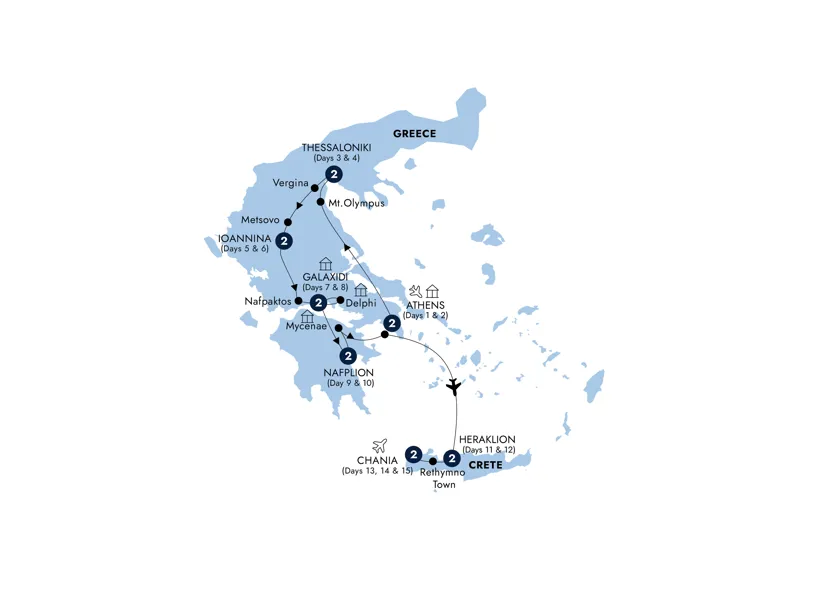
15 Day Tour of Greece to Athens, Mycenae & Crete
From
$5,250
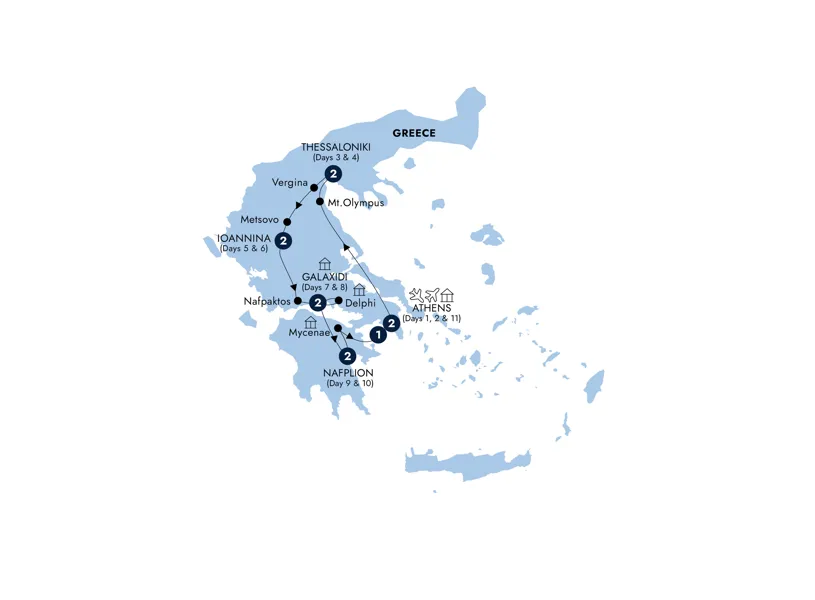

11 Day Greece Tour from Athens including Santorini
From
$4,629
$4,201


9 Day Greece Tour from Athens with One-Day Cruise
From
$2,650
$2,385


14 Day Greece Tour of Athens, Olympia & Santorini
From
$6,229


15-Day Small Group Greece Tour, Athens to Crete
From
$6,975
Why Explore Greek Mythology on a Guided Tour?
Reading the myths before visiting Greece can introduce you to the characters. Standing where their stories were told, worshipped and commemorated is different.
The challenge is understanding what you are looking at.
At Delphi, an expert can explain why the oracle wielded such influence. At Mycenae, archaeology helps separate what is known about the Bronze Age civilization from the later legends surrounding Agamemnon. At Olympia, temples and athletic grounds reveal the religious origins of the Olympic Games. In Athens, details carved into temples and sculptures provide clues to how the ancient Greeks understood their gods.
Guided travel also makes it easier to connect these places as part of a larger story. Rather than seeing a succession of archaeological sites, travelers can begin to see how mythology, religion, politics, art and everyday life intertwined across ancient Greece.
The myths may have been told thousands of years ago, but in Greece, many of the places behind them are still waiting to be explored.
Frequently Asked Questions About Greek Mythology and Travel


Athens, Delphi, the Archaeological Site of Mycenae, the Archaeological Site of Olympia, Heraklion and the Ancient Theatre of the Asklepieion at Epidaurus offer particularly strong connections to Greek mythology. Together, they introduce travelers to stories associated with Athena, Apollo, Agamemnon, Zeus, the Minotaur and Asclepius.
The Acropolis is one of the most important places to explore Athena's role in ancient Athens. The Parthenon was dedicated to Athena, and travelers can also see the Temple of Athena Nike and the Erechtheion. The Acropolis Museum provides additional context through sculptures and artifacts from the site.
Travelers can visit the archaeological site of Delphi and walk the Sacred Way to the remains of the Temple of Apollo, where the Oracle of Delphi delivered prophecies in the ancient world.
Mycenae is closely associated with Agamemnon in Greek epic tradition. The archaeological site itself was an important center of Mycenaean civilization. Travelers can walk through the Lion Gate and explore its citadel and royal beehive tombs.
Yes. At the Archaeological Site of Olympia, travelers can see the ancient stadium, athletes' gymnasium and remains of temples dedicated to Zeus and Hera. The ancient Olympic Games began there in 776 B.C.
The Minotaur and Labyrinth belong to Greek mythology rather than established archaeological history. The story is traditionally associated with King Minos and Crete, and the Palace of Knossos near Heraklion has long been linked with the legend. Travelers can explore the palace complex and see Minoan artifacts at the Heraklion Archaeological Museum.
Athena and Zeus feature prominently in Athens, Apollo is central to the story of Delphi, Zeus and Hera are closely connected to Olympia, and Asclepius is associated with the ancient healing sanctuary at Epidaurus. Greek heroes and legendary figures such as Agamemnon, Theseus and King Minos also have strong connections to places travelers can visit.
Many archaeological sites contain layers of mythology, religion and documented history that can be difficult to distinguish from the ruins alone. Local Experts and Specialists can explain what archaeologists know about a site while providing context for the myths and historical events associated with it.
Interested in Ancient Greece? You Might Also Like...


 Free Brochure
Order Your Free Brochure
Sign up to order your FREE travel brochure subscription and get exclusive offers only available to our subscribers
 Download Brochure
 View Brochure Online
 Shop Deals