




Visit England and explore vibrant cities, coastal towns, cathedrals, towers, forts, stone henges, and castles
Visiting Shakespeare's Birthplace:
A Stratford-upon-Avon Guide
A Stratford-upon-Avon Guide

In the historic market town of Stratford-upon-Avon, England, a timber-framed Tudor house marks the birthplace of William Shakespeare, one of the world's most influential playwrights. Born here in 1564, Shakespeare spent his early years surrounded by the traditions, language, and everyday life of Elizabethan England, experiences that would later influence his writing. Today, visitors can step inside his childhood home, explore the town's remarkably preserved Tudor architecture, and discover the places that shaped his life. For travelers exploring the best places to visit in England, Stratford-upon-Avon offers a fascinating connection to Britain's literary and cultural heritage.
What to Expect When Visiting Shakespeare's Birthplace
Located on Henley Street in the center of Stratford-upon-Avon, Shakespeare's Birthplace is a sixteenth-century house where William Shakespeare grew up with his parents, John Shakespeare and Mary Arden, and his siblings. The building's exposed timber beams, plaster walls, and traditional Tudor construction offer a glimpse into the domestic surroundings of a relatively prosperous Elizabethan family.
Inside, visitors can explore furnished rooms that recreate aspects of Tudor household life, including family living spaces and areas associated with John Shakespeare's glove-making business. Historical displays and objects from the Shakespeare Birthplace Trust's collections help illustrate the family's daily routines, social standing, and the world young William would have known. The house also features exhibitions exploring how Shakespeare's upbringing and surroundings contributed to his development as a writer.
Unlike a grand palace or aristocratic estate, Shakespeare's Birthplace offers an intimate perspective on sixteenth-century England. Its rooms and furnishings reveal how a successful tradesman's family lived, worked, and raised children during the Tudor period.

The History of Shakespeare's Birthplace
William Shakespeare was born in Stratford-upon-Avon in April 1564, during the reign of Queen Elizabeth I. Although his exact birth date is unknown, April 23 is traditionally celebrated as his birthday. His father, John Shakespeare, was a glove maker, wool dealer, and prominent member of Stratford's civic community, while his mother, Mary Arden, came from a farming family in the surrounding Warwickshire countryside.
Shakespeare likely attended the town's grammar school, where he would have studied Latin, classical literature, and rhetoric. As a young man, he married Anne Hathaway in 1582 before establishing his theatrical career in London. There, he became a successful actor, playwright, and shareholder in the Lord Chamberlain's Men, the theatrical company later known as the King's Men.
Despite his success in London, Shakespeare maintained close connections to Stratford-upon-Avon. In 1597, he purchased New Place, one of the town's largest residences, where he spent time with his family and eventually lived during his final years. He died in Stratford in 1616 and was buried at Holy Trinity Church.
Why Was Shakespeare's Birthplace Preserved?
One of the most remarkable stories associated with Shakespeare's Birthplace is how close the historic house came to being lost. By the nineteenth century, the property had undergone significant changes and had been divided into commercial and residential spaces. When it was offered for sale in 1847, concerns grew that the building could be altered, demolished, or even removed from England.
A public campaign, supported by prominent literary figures including Charles Dickens, raised funds to purchase the property for £3,000. The successful effort led to the establishment of the Shakespeare Birthplace Trust, which has protected the house and other Shakespeare-related landmarks for generations.
Preserving Shakespeare's Birthplace safeguards more than the childhood home of a celebrated writer. The building provides a rare physical connection to Tudor domestic life, traditional craftsmanship, and the social environment of Elizabethan England. While Shakespeare's plays preserve the language, ideas, and dramatic traditions of his era, his birthplace allows visitors to experience the architectural and cultural setting in which his story began.

Best Places to Visit in Stratford-upon-Avon
Beyond Shakespeare's Birthplace, Stratford-upon-Avon contains several historic landmarks connected to the playwright's education, marriage, family life, and enduring literary legacy. Many are located within the town's walkable historic center, while others require a little additional travel time.
Shakespeare's Schoolroom and Guildhall
A short walk from Shakespeare's Birthplace, the historic Guildhall houses the grammar school where Shakespeare is believed to have studied. Visitors can explore the schoolroom and learn about Tudor education, when Latin grammar, classical literature, and rhetoric formed the foundation of academic instruction. These subjects would later influence the language, historical references, and dramatic structure of Shakespeare's plays.
Shakespeare's New Place
In 1597, Shakespeare purchased New Place, one of the largest and most prestigious residences in Stratford-upon-Avon, reflecting his growing wealth and success as a playwright. Located on Chapel Street, just a short walk from Shakespeare's Birthplace, the substantial Tudor property included a large house, courtyard, and gardens where Shakespeare lived with his family and spent his final years. Although the house was demolished in the eighteenth century, its grounds have been transformed into landscaped gardens featuring contemporary sculptures and exhibitions exploring Shakespeare's life and legacy. Visitors can walk through the former estate and discover the site where Shakespeare died in 1616, offering a glimpse into his life beyond the London stage.
Holy Trinity Church
Located along the River Avon, approximately a 10-minute walk south of Shakespeare's New Place, Holy Trinity Church is where William Shakespeare was baptized in 1564 and buried in 1616. Visitors can enter the church's chancel to pay their respects at his grave, which lies near the high altar alongside those of his wife, Anne Hathaway, and other family members. His gravestone bears a curious warning, traditionally attributed to Shakespeare himself: "Blessed be the man that spares these stones, and cursed be he that moves my bones." Above his resting place stands a memorial featuring a sculpted bust of the playwright, considered one of his most important surviving likenesses. Each April, during Shakespeare's Birthday Celebrations, flowers and sprigs of rosemary are laid at his grave in tribute to the playwright. Rosemary, a traditional symbol of remembrance, holds special significance in Shakespeare's work, appearing in Hamlet when Ophelia declares, 'There's rosemary, that's for remembrance.'
The Royal Shakespeare Theatre
Situated on the banks of the River Avon, approximately a 5-minute walk from Holy Trinity Church, the Royal Shakespeare Theatre is home to the Royal Shakespeare Company, which continues to perform and reinterpret Shakespeare's plays for modern audiences. Originally built in 1932, the theater retains elements of its Art Deco architecture while featuring a modern thrust stage that extends into the audience, recreating the intimate theatrical experience of Shakespeare's Elizabethan playhouses. Visitors can also explore the theater's public spaces and enjoy panoramic views of Stratford-upon-Avon from its observation tower, which rises approximately 118 feet above the ground. The theater remains a living tribute to Shakespeare's legacy, connecting his hometown with the dramatic traditions that made him internationally famous.
Anne Hathaway's Cottage
Located in the village of Shottery, approximately a mile and a half from Shakespeare's Birthplace, Anne Hathaway's Cottage was the childhood home of Shakespeare's wife and the place where the young playwright is believed to have courted her before their marriage in 1582. Originally built in 1463 as a farmhouse, the picturesque thatched residence remained in the Hathaway family for 13 generations and preserves historic architectural features and family furnishings, including an intricately carved four-poster bed. Visitors can explore the historic rooms where Anne grew up before wandering through nine acres of traditional English cottage gardens, orchards, and a sculpture trail inspired by Shakespeare's plays. The beautifully preserved property offers a rare glimpse into the personal life of Shakespeare and the rural English setting where his relationship with Anne began.
Exploring Stratford-upon-Avon's Tudor Streets and Riverside
Stratford-upon-Avon is worth exploring beyond its famous literary landmarks. The historic town center features black-and-white timber-framed buildings, centuries-old shops, and streets that reflect its origins as a medieval market town. Henley Street, High Street, and the surrounding lanes offer opportunities to appreciate traditional English architecture and the character of a town that has welcomed visitors for generations.
The River Avon provides a scenic contrast to the busy town center, with landscaped gardens, walking paths, and views of the Royal Shakespeare Theatre. Visitors with free time can enjoy a leisurely walk along the waterfront or stop at a traditional tearoom to experience English cream tea and other British tea traditions.
Why Shakespeare's Birthplace Is Worth Visiting
William Shakespeare's influence extends far beyond literature and the theater. His plays and sonnets explore universal themes of love, ambition, betrayal, and human nature, while his creative use of language helped popularize words and expressions that remain part of modern English. His literary legacy also provides an interesting perspective on the evolution of British words and phrases.
Visiting Shakespeare's Birthplace connects that remarkable literary achievement with the ordinary surroundings of his childhood. The preserved Tudor house, historic streets, and nearby landmarks reveal the world Shakespeare knew before becoming one of history's most celebrated writers. Among the best places to visit in the United Kingdom, Stratford-upon-Avon offers a distinctive opportunity to explore England's history through the life of a single extraordinary figure.



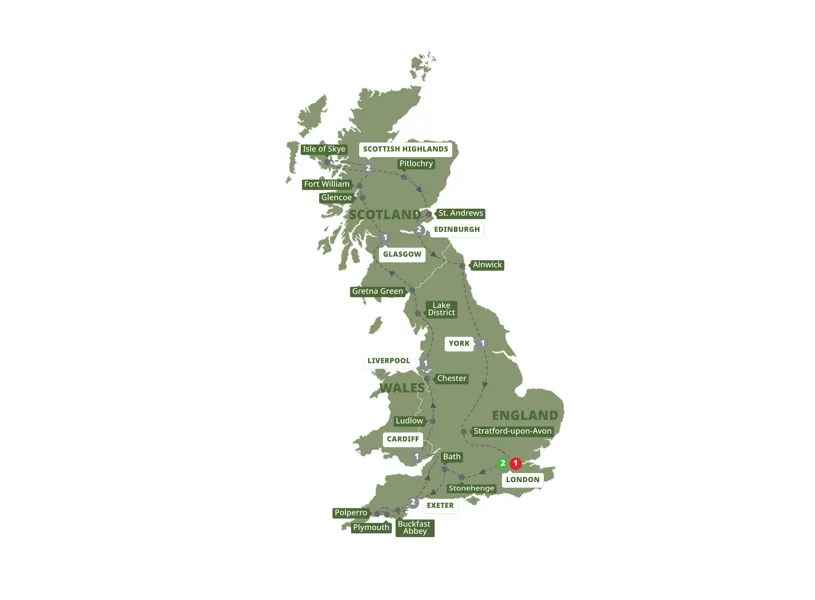

11 Day Tour of England, Scotland & Wales
From
$4,425
$3,761


10 Day UK & Ireland Tour of England, Scotland
From
$3,350
$2,848


24 Day Tour of England, Scotland & Ireland
From
$10,050
$8,543


15 Day Tour to England, Scotland, Wales & Ireland
From
$6,625
$5,631


10 Day Britain & Ireland Tour to Glasgow, Dublin
From
$1,895
$1,706


Why Visit Shakespeare's Birthplace on a Guided Tour?
Visiting Shakespeare's Birthplace as part of a guided tour adds historical context and a deeper understanding of the people, places, and traditions that shaped his life. Expert insights help connect the Tudor house and surrounding town to the social and cultural world of Elizabethan England, revealing details visitors might otherwise overlook. Understanding Shakespeare's upbringing, education, and enduring influence brings greater meaning to the experience, while time to explore Stratford-upon-Avon offers an opportunity to appreciate the town's historic architecture and literary heritage at your own pace.
Frequently Asked Questions About Visiting Shakespeare's Birthplace


Shakespeare's Birthplace is located on Henley Street in Stratford-upon-Avon, Warwickshire, England, approximately 100 miles northwest of London. The historic market town is a popular stop on guided tours of England and Great Britain, offering visitors an opportunity to experience Tudor architecture and explore the life of William Shakespeare.
Visitors can explore the historic Tudor house where William Shakespeare grew up, including furnished rooms that illustrate everyday life in sixteenth-century England. Exhibitions and historical interpretation reveal details about Shakespeare's family, his father's glove-making trade, and the cultural environment that influenced his early life.
Shakespeare's Birthplace is featured on select guided tours of England and Great Britain, either as an included sightseeing experience or an optional excursion. Depending on the itinerary, travelers may also enjoy free time to explore Stratford-upon-Avon's historic streets, shops, and riverside attractions.
Stratford-upon-Avon is home to several landmarks associated with Shakespeare, including his former schoolroom, the site of New Place, Holy Trinity Church, and the Royal Shakespeare Theatre. The town is also known for its traditional Tudor buildings, charming streets, and scenic River Avon. Opportunities to visit individual attractions depend on the tour itinerary and available free time.
Shakespeare's Birthplace is one of the few surviving buildings directly associated with the playwright's childhood. Preserved through a public campaign in 1847, the house provides valuable insight into Tudor domestic life and the Elizabethan society that influenced Shakespeare's writing. Its preservation also represents an important chapter in Britain's cultural heritage conservation.
Absolutely. Stratford-upon-Avon offers an engaging introduction to Tudor England, with historic timber-framed buildings, centuries-old streets, and a rich cultural heritage. Visiting Shakespeare's Birthplace provides insight into everyday life during the Elizabethan period, making it a rewarding experience for travelers interested in English history, architecture, and literature alike.
Interested in Visiting Shakespeare's Birthplace in England? You Might Also Like...


 Free Brochure
Order Your Free Brochure
Sign up to order your FREE travel brochure subscription and get exclusive offers only available to our subscribers
 Download Brochure
 View Brochure Online
 Shop Deals