




Italy’s artistic legacy is not confined to museums. It unfolds in the cities, churches, and landscapes where these masterpieces were created. Experiencing these places firsthand offers a deeper understanding of the people, ideas, and cultural traditions that shaped them.
The Art of Italy: A Guide to
Renaissance Masterpieces
& Cultural Icons
Renaissance Masterpieces
& Cultural Icons
Exploring Italian Art from Florence to the Vatican

Italy offers one of the most complete artistic narratives in the world. Across its cities, art is not confined to galleries. It lives in public squares, churches, and everyday spaces. From the early innovations of Giotto, which marked a shift toward realism and human expression, to the intellectual breakthroughs of the Renaissance and the grandeur of Rome, Italy reveals how art shaped identity, belief, and power. Artists worked across a range of mediums, from marble and fresco to glass and mosaic, each influencing how art was created and experienced.
To understand Italian art is to understand the ideas and people behind it. Each region in Italy contributes a distinct chapter, forming a layered cultural narrative that continues to shape global art today. This guide highlights key Renaissance works across Italy, from Florence to the Vatican, explaining what to see and why it matters.
Florence and the Birth of Renaissance Art
Florence stands at the foundation of the Renaissance, a movement that began in the 14th century and reshaped the direction of art and thought across Europe. The earliest developments took place here in the 1300s, when a profound shift in thinking began to take hold. Its origins can be traced to local figures like Giotto, whose work marked a decisive move toward naturalism and emotional depth. Drawing on classical antiquity, artists and scholars in Florence began to prioritize observation, proportion, and the study of the human form, supported by a culture that valued education and intellectual inquiry.
From this foundation, the Renaissance gained momentum through the 15th century and reached its height in the 16th century. Artists refined techniques such as linear perspective, anatomical precision, and the use of light and shadow to create depth. Art moved beyond symbolic representation into a disciplined practice grounded in science and theory, establishing a visual language that extended far beyond Florence and set the stage for continued innovation.
The Medici Family and the Rise of Artistic Innovation
This environment was sustained and expanded through the influence of the Medici family. Their patronage supported artists who would come to define the Renaissance, including Michelangelo and Botticelli. With this support, artists moved beyond medieval traditions to study anatomy, proportion, and perspective with greater precision, transforming art into a reflection of human experience, intellect, and beauty. Florence became a place where ideas were actively tested and refined, fostering the emergence and flourishing of new techniques.

Brunelleschi’s Dome tops Florence Cathedral in Florence, a landmark of Renaissance innovation
Brunelleschi’s Dome and Architectural Innovation
One of the earliest and most visible expressions of this shift can be seen in architecture. Filippo Brunelleschi’s dome for Florence Cathedral, Santa Maria del Fiore, redefined what was possible through its scale and engineering. Its precise proportions emphasize harmony and mathematical order, reflecting the Renaissance focus on balance and reason. The dome became a symbol of Florence’s ambition and intellectual confidence.
Inside, Giorgio Vasari and Federico Zuccari’s fresco of The Last Judgment extends this vision across the dome’s interior, filling the space with a dynamic depiction of heaven and hell. Figures rise and fall in layered movement, contrasting with the dome’s structural clarity while reinforcing its sense of order. Together, architecture and painting create a unified experience, where innovation in form shapes both visual and spiritual understanding. These same principles of structure and spatial organization would soon be applied more directly to visual storytelling, particularly in the development of perspective.

The Gates of Paradise, Lorenzo Ghiberti’s gilded bronze doors, showcase remarkable depth and early use of perspective, Florence, Italy
The Gates of Paradise and the Emergence of Perspective
The Gates of Paradise are one of Florence’s most important artistic landmarks, marking a key moment in the development of Renaissance art. Created by Lorenzo Ghiberti for the Baptistery of San Giovanni, the gilded bronze panels depict scenes from the Old Testament with a new sense of depth and spatial awareness. Figures are arranged within carefully constructed architectural and natural settings, illustrating an early use of linear perspective in relief sculpture. Rather than appearing flat or symbolic, the scenes unfold with movement and narrative clarity. As artists gained greater control over space and depth, these ideas began to influence not only relief work, but fully three-dimensional sculpture.
Donatello and the Foundations of Renaissance Sculpture
As these advances in perspective, realism, and narrative took hold, artists began to explore them beyond the surface and into three-dimensional form. Donatello, in particular, introduced a heightened level of naturalism and individuality to sculpture. His earlier David, smaller in scale and more introspective, marked a shift away from rigid forms toward a more human-centered approach. These innovations laid the groundwork for the monumental achievements that followed. This shift toward lifelike representation would reach its fullest realization in the work of Michelangelo.

Michelangelo’s David embodies strength and human potential in a moment of poised tension, Florence, Italy
Michelangelo’s David and the Renaissance Ideal
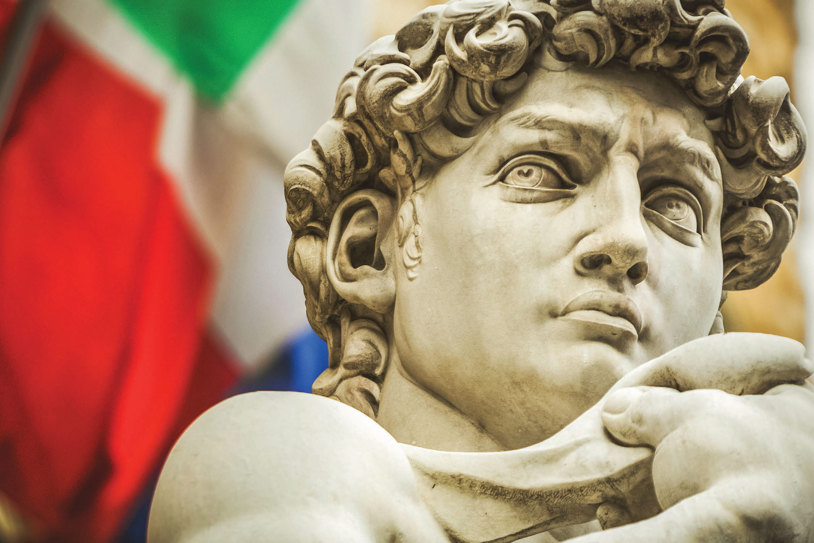
Advancing the naturalism and human-centered approach introduced by Donatello, Michelangelo’s David embodies the Renaissance focus on individual strength and intellectual agency. Carved from a single block of marble, the sculpture’s monumental scale, anatomical precision, and controlled tension reflect both technical mastery and a deep engagement with human potential. Michelangelo captures David not in victory, but in a moment of pre-battle anticipation. In the biblical story, David is a young shepherd who defeats the giant Goliath against overwhelming odds, making him a symbol of courage and faith. By depicting him before the battle, Michelangelo heightens the psychological intensity of the figure. Much more than a religious hero, the famous sculpture conveys confidence, independence, and quiet resolve.
Michelangelo’s unfinished Prisoners, a series of four sculpted statues, further illuminate his artistic process and evolving ideas about form. Their partially carved bodies appear to struggle free from the stone, creating a powerful visual metaphor for the relationship between material and imagination. This technique, often described as non-finito, meaning “unfinished” in Italian, reflects Michelangelo’s belief that the figure already exists within the marble, and that the artist’s role is to remove what does not belong. In these works, partially carved forms reveal that process in action, with some areas fully realized while others remain embedded in rough stone. Rather than presenting a single, completed state, the sculptures capture a moment of emergence, as if the figures are in the act of coming into being.
As these ideas took hold, sculpture moved beyond the artist’s workshop and into the public sphere, where it could shape civic identity as well as artistic standards. Works like David, displayed prominently in Florence, became symbols of political strength and cultural pride, demonstrating how art could communicate shared values while also pushing the boundaries of artistic expression.

Loggia dei Lanzi, also known as the Loggia della Signoria, located in the Piazza della Signoria in Florence, Italy
Piazza della Signoria and the Power of Public Art
As artistic advancements began to influence more artists and patrons, Florence itself became a stage for their display. Art was not confined to interiors. The city’s central public square, Piazza della Signoria, demonstrates how sculpture and architecture were used to express civic identity and political power. The town hall, Palazzo Vecchio, rises as a symbol of authority, while the open-air gallery of the Loggia dei Lanzi presents a curated display of sculpture drawn from mythology and history, each work reinforcing ideas of strength, conflict, and control.
Among its most striking works is Benvenuto Cellini’s Perseus with the Head of Medusa, which depicts the mythological hero holding the severed head of Medusa, a 'monster' whose gaze could turn men to stone. The dramatic pose and polished bronze surface emphasize both technical mastery and the triumph of order over chaos. Nearby, Giambologna’s Rape of the Sabine Women captures three intertwined figures carved from a single block of marble, illustrating an episode from early Roman history in which women were abducted to secure the future of the state. The spiraling composition invites viewers to move around the sculpture, engaging with it from multiple perspectives. Other works, such as Hercules and the Centaur Nessus, continue this theme of struggle and dominance, reinforcing the visual language of power throughout the space.
Nearby, the Fountain of Neptune, designed by Bartolomeo Ammannati under Medici patronage, adds another dimension to the piazza. Its central figure, modeled as the Roman god of the sea, represents Florence’s maritime ambitions and expanding influence. Together, these monuments transform the square into more than a gathering place. They create a carefully constructed visual narrative in which heroes, rulers, and gods embody the authority and aspirations of the city.
The integration of these works into a public setting reinforces the idea that art was part of everyday life, accessible to all who passed through the piazza. In Florence, sculpture was not only decorative but communicative, shaping how power, identity, and history were understood. This model of public art became a defining feature of the Renaissance and influenced how other cities used visual culture to project their own values. At the same time, this civic and political use of art was matched by a renewed interest in classical mythology and philosophical ideals, particularly in painting.

Botticelli’s Birth of Venus in Florence captures ideal beauty through flowing form, balance, and classical inspiration
Botticelli and the Revival of Classical Beauty
Sandro Botticelli’s Birth of Venus perfectly captures the Renaissance revival of classical mythology, presenting beauty as both a natural and intellectual ideal. The painting depicts Venus, the Roman goddess of love, emerging from the sea on a shell, a scene drawn from ancient myth in which she is born from sea foam. She is carried to shore by the wind gods, while a female figure waits to cloak her, signaling her arrival into the human world. Botticelli’s composition is defined by flowing lines, delicate movement, and balanced form, creating a sense of harmony rather than strict realism.
Beyond its visual elegance, the work reflects Renaissance humanism, which sought to reconcile classical philosophy with contemporary thought. Venus is not only a mythological figure but also an embodiment of ideal beauty, associated with both physical perfection and higher, intellectual love. Supported by Medici patronage, the painting demonstrates how Florence embraced subjects beyond traditional religious themes, drawing on ancient sources to expand the meaning and purpose of art. As these ideas developed, Renaissance art began to move beyond Florence, where artists pushed further into experimentation and intellectual inquiry.
Milan and Leonardo da Vinci’s Lasting Influence
Milan represents a pivotal phase in the evolution of Renaissance art, where innovation and intellectual inquiry expanded beyond the groundwork laid in Florence. While Florence established core principles such as perspective, naturalism, and classical revival, Milan became a center for deeper experimentation, particularly through the work of Leonardo da Vinci. Here, art was treated as both a creative and scientific discipline, integrating observation, mathematics, and human psychology. This approach extended the achievements of earlier artists, positioning Milan as a key link between the foundational developments in Florence and the monumental works that would later emerge in Rome..

The Last Supper by Leonardo da Vinci, in the convent of Santa Maria delle Grazie in Milan, Italy
The Last Supper and the Power of Composition
Leonardo da Vinci’s The Last Supper marks a turning point in Renaissance art by uniting precise perspective, individualized emotion, and narrative clarity within a single, cohesive composition. Painted on the wall of Santa Maria delle Grazie in Milan, the work captures a charged moment from the Bible, when Christ tells his disciples that one of them will betray him. Rather than presenting a static scene, Leonardo depicts the immediate reactions of the apostles, each figure responding with distinct gestures and expressions that convey shock, disbelief, and tension.
The composition is carefully structured, with all lines of perspective converging on Christ, placing him at both the visual and symbolic center. Leonardo’s use of grouped figures and controlled movement creates a sense of order while allowing for variation in human response. His experimental technique, including the use of layered paint and sfumato, produces subtle transitions of light and shadow, giving the scene a naturalistic depth and softness. Although the work proved fragile over time, its integration of space, emotion, and storytelling set a new standard for artistic practice.
Innovation, Technique, and Lasting Impact
Leonardo’s study of anatomy, light, and human behavior reshaped artistic standards, encouraging a more analytical and observational approach. Leonardo also advanced the use of linear perspective beyond earlier artists like Ghiberti by applying a single, unified system that creates a more coherent and immersive sense of space, strengthening both the visual clarity and emotional impact of the scene. Rather than relying solely on tradition, artists began to study the natural world directly, blending scientific inquiry with creative practice.
Leonardo’s Vitruvian Man further illustrates this thinking. The drawing depicts a male figure positioned within both a circle and a square, based on ideas from the ancient Roman architect Vitruvius, who believed that the proportions of the human body reflect universal principles of order and balance. By aligning the body with geometric forms, Leonardo demonstrates the connection between human anatomy, mathematics, and the structure of the natural world.
Together, these works show how Renaissance art moved beyond symbolic representation toward greater naturalism, precision, and psychological depth, setting new standards for how artists understood both the human body and the world around it. These innovations also laid the groundwork for the High Renaissance, where the principles developed in Florence and expanded in Milan were brought together and intensified in Rome.
Rome and the Height of Renaissance Achievement
If the artists of Florence established the Renaissance and figures like Leonardo in Milan expanded its intellectual and technical possibilities, Rome’s masters brought these developments to a new level of ambition and cohesion. Supported by the authority and vision of the Papacy, artistic production increased in scale, complexity, and purpose. In Rome, particularly within the Vatican, art was no longer only an exploration of human potential. It became a unified statement of power, faith, and intellectual authority, bringing together ideas first developed in Florence and advanced in Milan. The works produced during this time represent the height of the High Renaissance, when innovation, technical mastery, and clarity of vision were fully realized in monumental form.

A section of the Sistine Chapel ceiling featuring Michelangelo’s “The Creation of Adam” in the Vatican
Art in the Vatican and the Sistine Chapel
The Vatican presents a concentrated view of artistic evolution, culminating in the work of the High Renaissance masters. Within this setting, painting, sculpture, and philosophy converge into a statement shaped by the authority of the Papacy. Even the movement through the Vatican reflects this artistic intention. The Bramante Staircase, with its spiraling design and careful symmetry, illustrates how architectural innovation shaped the visitor experience as much as the works themselves. This integration of space and meaning continues in the monumental works that define the Vatican’s artistic legacy.
Michelangelo’s Sistine Chapel ceiling transforms architectural space into a continuous narrative. Across the vaulted surface, scenes from the Book of Genesis unfold, surrounded by monumental figures that twist, reach, and recline with striking physical presence. These figures illustrate anatomical precision and emotional intensity, building on the study of the human form first explored in Florence. Trained as a sculptor, Michelangelo approached painting with a focus on structure and mass, giving his figures a sense of weight and movement that redefined what fresco could achieve. His work reflects both technical mastery and a deep engagement with the human condition, where spiritual themes are conveyed through the body itself.

Raphael’s School of Athens, in the Vatican, reflects harmony and intellectual clarity through balanced composition
Raphael’s rooms offer a refined counterpoint. In his painting, The School of Athens, a grand architectural setting opens into a gathering of philosophers, where figures stand, walk, and debate across a carefully organized space. At the center, Plato and Aristotle move forward in conversation, anchoring the scene both visually and intellectually. Around them, each figure is arranged with clear proportion and spatial awareness, creating movement within a unified whole. Where Michelangelo emphasized tension and power, Raphael focused on harmony and intellectual precision. His compositions guide the viewer through complex ideas with ease, reinforcing a vision of knowledge shaped by order and balance.

Michelangelo’s Pietà captures quiet grief through balanced form and lifelike detail and can be visited in St. Peter's Basilica
St. Peter’s Basilica and the Union of Art and Faith
St. Peter’s Basilica represents the integration of architecture, sculpture, and spiritual meaning on a monumental scale. It is both a place of worship and a carefully constructed artistic statement shaped by the ambitions of the Papacy.
Michelangelo’s Pietà, created early in his career, captures a moment of quiet grief with remarkable restraint. The Virgin Mary cradles the lifeless body of Christ across her lap, her expression composed rather than overtly sorrowful. The smooth marble and flowing drapery contrast with the weight of Christ’s form, revealing Michelangelo’s ability to transform stone into a lifelike presence. Through subtle gestures and balanced composition, he conveys emotion without dramatic movement. This work established his reputation and embodies the Renaissance pursuit of clarity, harmony, and idealized beauty.
Above, the dome designed by Michelangelo defines the skyline and symbolizes aspiration. Inspired by Brunelleschi’s earlier dome in Florence, it builds on Renaissance principles of proportion and engineering at a far greater scale. Its structure demonstrates a deep understanding of both form and function, uniting artistic vision with technical precision. It reflects the broader Renaissance goal of harmony between human creativity and the physical world.
Bernini’s colonnade extends this vision into the surrounding space, creating a sense of movement and embrace. Its sweeping arms guide visitors into the square, shaping both physical experience and emotional response. Through this integration of architecture and environment, the space reinforces the connection between art, authority, and belief. Together, these elements create a unified experience where artistic achievement and spiritual meaning are inseparable.
Venice and the Art of Light and Craftsmanship
While Florence emphasized structure and Rome emphasized monumental scale, Venice prioritized sensory experience and visual richness. Built on water and shaped by shifting light, the city developed an artistic identity centered on color, reflection, and material rather than strict form. This approach set Venice apart, offering a more fluid and immersive interpretation of artistic beauty.

Example of a handcrafted Venetian glass chandelier in Venice, Italy, where centuries of artistry meet delicate, luminous design
Venetian Glass and Decorative Arts
Venetian glassmaking stands as one of the city’s most refined artistic traditions, with Murano glass at its center. Developed over centuries on the island of Murano, this craft balances technical precision with creative experimentation. Artisans transformed molten glass into intricate forms, incorporating vibrant color, delicate pattern, and remarkable clarity.
Among the most celebrated achievements was the development of exceptionally clear glass, which led to the rise of Venetian mirrors as luxury objects across Europe. Often framed with ornate glasswork, these mirrors became symbols of status and craftsmanship, valued for both their reflective quality and artistic design. These works reveal a mastery of material, where transparency and light become essential elements of the composition. Glassmaking in Venice represents more than decoration. It reflects a broader artistic philosophy that emphasizes transformation and the relationship between material and environment.
Color, Reflection, and Atmosphere
Venice’s environment plays a central role in shaping its artistic character. Water and light interact constantly, creating reflections that shift throughout the day. This dynamic setting encouraged artists to focus on color, tone, and visual experience rather than rigid composition.
Paintings associated with Venice often emphasize softness and movement. Venetian painters such as Titian defined this approach, using rich color and layered surfaces to create depth and visual richness rather than relying on strict structure. Edges soften, colors blend, and scenes feel immersive rather than fixed. This sensitivity to light parallels the qualities seen in Murano glass and Venetian mirrors, where surface and illumination shape perception.
In contrast to the structural clarity of Florence and the monumental scale of Rome, Venice offers a more fluid interpretation of art, where light, color, and material define the experience as much as form itself. Together, these cities form a continuous narrative, each building on the innovations of the last.
Palermo and the Fusion of Artistic Traditions
While Sicily is best known for its fusion of artistic traditions, painters such as Antonello da Messina introduced Renaissance techniques, blending Italian composition with Northern European realism. Positioned at the crossroads of the Mediterranean, the island absorbed ideas from Byzantine, Arab, and Norman civilizations, each leaving a distinct imprint. This convergence created a visual language that differs from mainland Italy, where styles evolved more linearly. Here, artistic expression became a dialogue between traditions, combining intricate pattern, symbolic imagery, and architectural innovation. The result is not a single dominant style, but a layered history in which multiple cultures coexist, creating a uniquely rich visual identity.

Mosaics of the Palatine Chapel in Palermo, Sicily, a UNESCO-listed Arab Norman monument
The Palatine Chapel and Byzantine Mosaics
The Palatine Chapel stands as one of the most compelling examples of artistic fusion in Italy. Its interior is richly adorned with mosaics depicting biblical scenes with remarkable precision and detail. These works draw on strong Byzantine influence through their use of gold backgrounds and stylized figures. At the same time, Islamic design appears in the geometric patterns and decorative ceilings, while Norman architectural structure frames the setting. Together, these elements form a unified yet complex visual experience. The chapel does not present a single tradition, but a carefully balanced composition of cultures.
Symbolism and Sacred Imagery
At the center of the chapel is Christ Pantocrator, a commanding image of divine authority. The figure’s scale and placement establish a clear sense of order and hierarchy. Gold surfaces and rich color deepen the spiritual atmosphere, while natural light shifts across the mosaics throughout the day, bringing subtle movement to the imagery. The result is an environment where art, architecture, and symbolism work together seamlessly. Each element contributes to a cohesive whole that conveys both religious meaning and cultural complexity.
Timeline of Italian Renaissance Art
This timeline traces the evolution of Italian Renaissance art through its most influential cities and figures, from the intellectual foundations established in Florence to the innovations of Leonardo da Vinci in Milan and the monumental achievements of Michelangelo and Raphael in Rome.

The evolution of Italian Renaissance art from Giotto to Raphael, highlighting Florence, Milan, and Rome as centers of innovation
Italian Renaissance art developed through a progression of ideas rather than isolated achievements. Early advances in realism and storytelling emerged in Assisi with Giotto, setting the stage for the intellectual and artistic breakthroughs of Florence. Florence established the foundation of Renaissance thought through patronage, experimentation, and a focus on human potential. These ideas expanded in Milan, where Leonardo da Vinci introduced new approaches to composition and perspective in The Last Supper. In Rome, Renaissance art reached its fullest expression. Michelangelo and Raphael brought together technical mastery, balance, and philosophical depth, defining what is now considered the height of artistic achievement in Italy.
Art-Lovers Bucket List Italy Trips
From Florence’s masterpieces to the Vatican’s monumental works, experiencing Renaissance art in person offers a deeper understanding of its scale, detail, and meaning. Explore guided tours across Italy to see these works within their original settings.
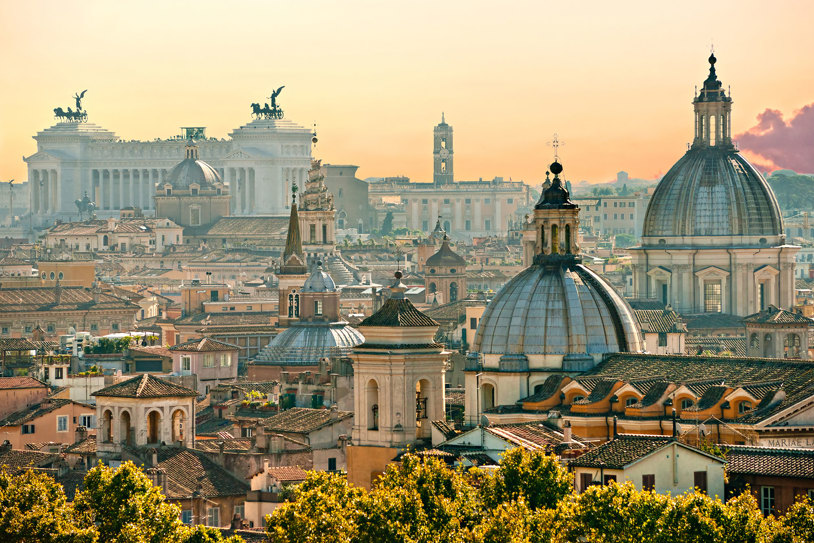

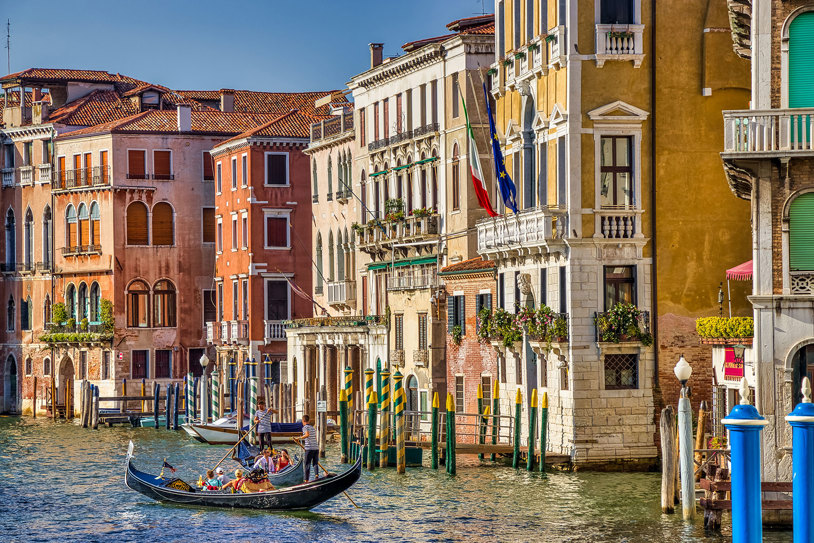


16 Day Italy Tour to Venice, Lucca & Perugia
From
$6,750
$6,075
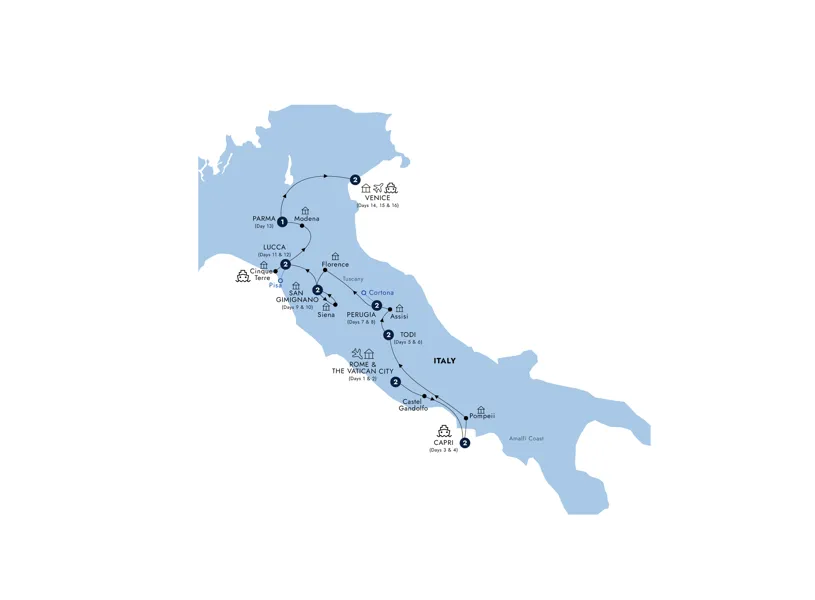


8 Day Italy Tour of Milan, Cinque Terre
From
$2,250
$2,025


11 Day Tour to Isle of Capri, Venice & Florence
From
$5,475
$4,928
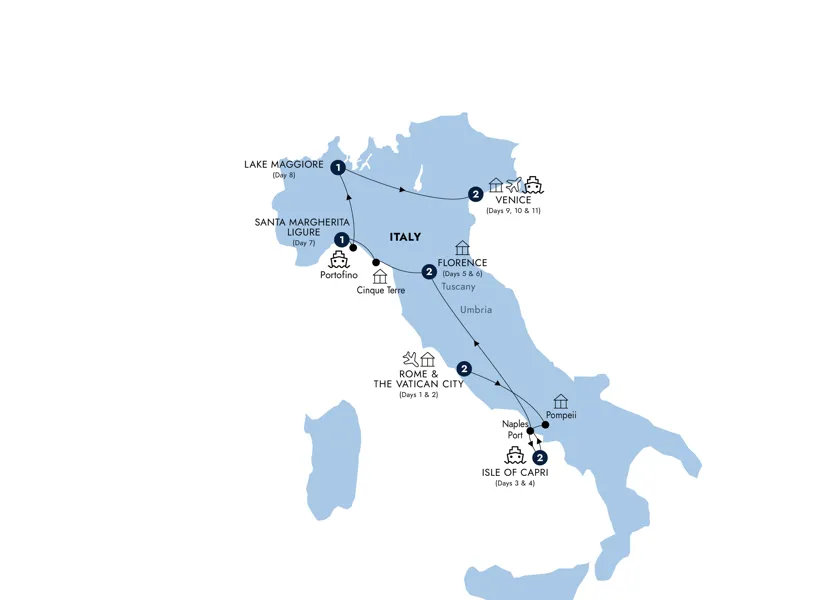

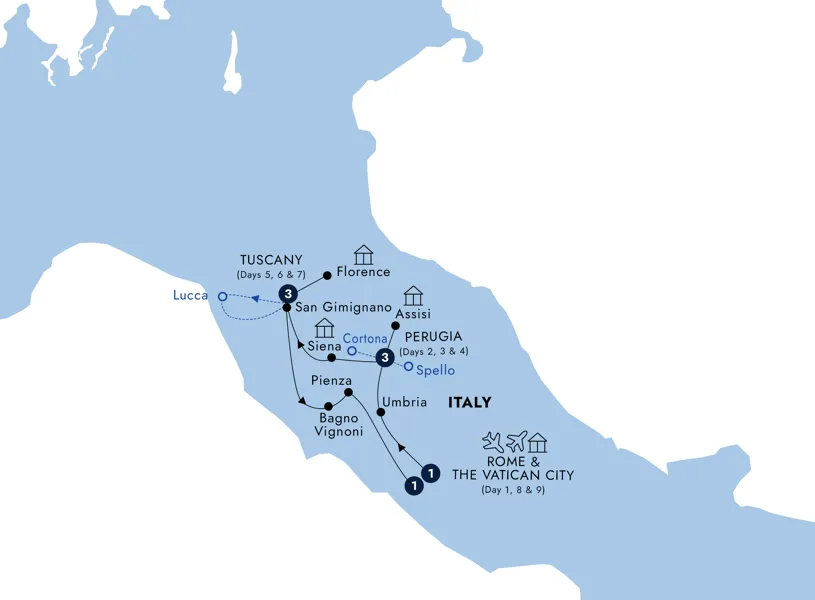
9 Day Italy Tour to Rome, San Gimignano & Perugia
Insight Vacations
From
$2,925
$2,633


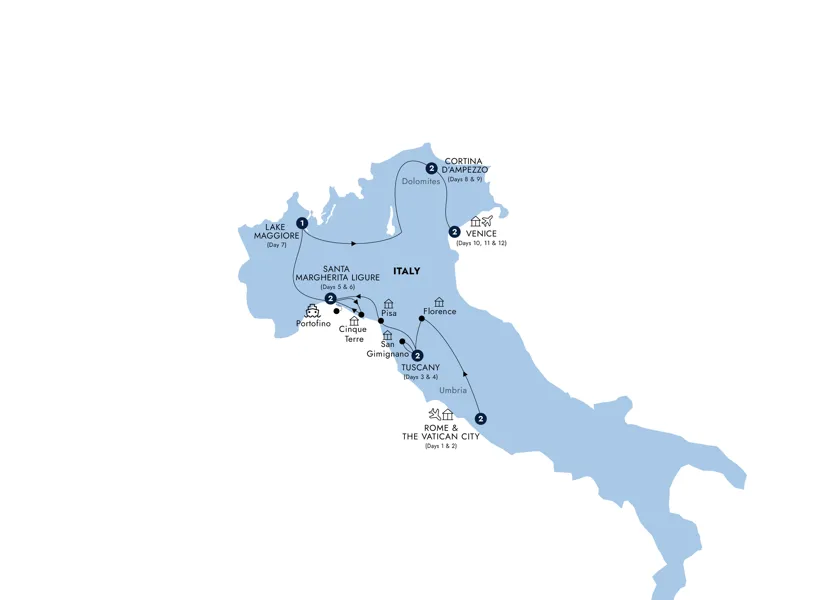
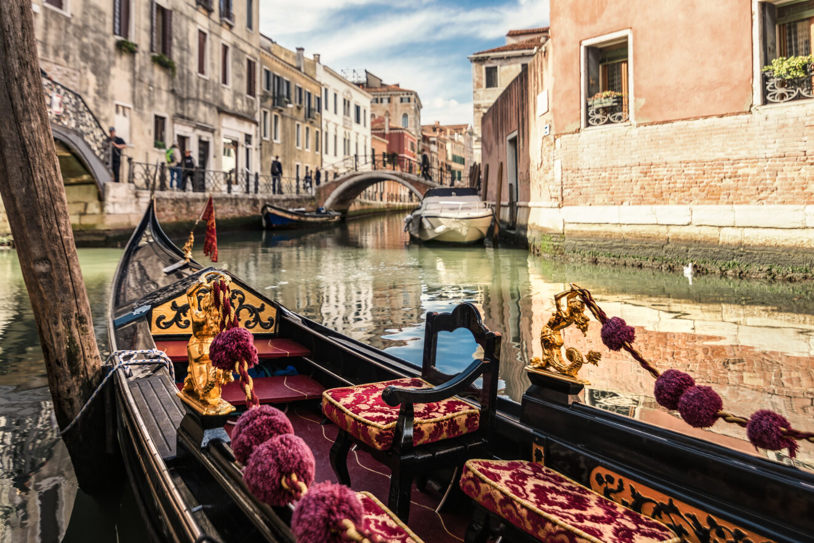
8 Day Tour of Florence, Venice & Vatican City
From
$3,095
$2,786



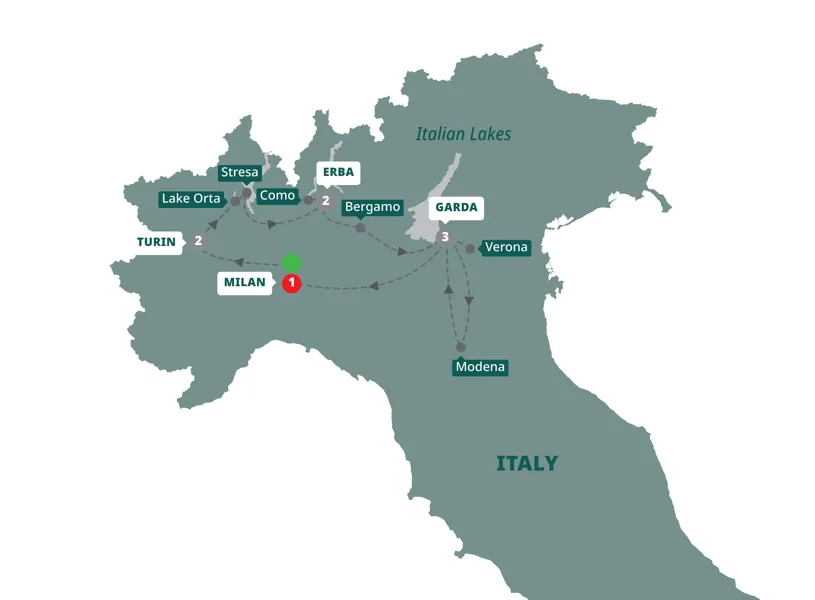
9 Day Tour to Milan, Lake Como & Lake Garda
From
$2,650
$2,385
Key Renaissance Artists Featured
| Date | Artist | Key Work | Location | Contribution |
|---|---|---|---|---|
| c. 1267–1337 | Giotto | Basilica of St. Francis Frescoes | Assisi | Introduced realism and emotional depth to painting |
| 1445–1510 | Sandro Botticelli | The Birth of Venus | Florence | Combined classical mythology with Renaissance ideals of beauty |
| 1475–1564 | Michelangelo | David, Sistine Chapel, Pietà | Florence, Rome | Mastered human anatomy and monumental artistic expression |
| 1452–1519 | Leonardo da Vinci | The Last Supper | Milan | Advanced composition, perspective, and scientific observation |
| 1483–1520 | Raphael | School of Athens | Vatican City | Defined balance, harmony, and clarity in composition |
| 1598–1680 | Gian Lorenzo Bernini | St. Peter’s Colonnade | Rome | Integrated sculpture and architecture into dynamic spatial design |
Key Terms in Renaissance Art
Historical Periods
-
Renaissance
A cultural and artistic movement that began in Italy in the 14th century, characterized by a revival of interest in the art, literature, and ideas of ancient Greece and Rome, along with a focus on human potential and observation of the natural world. -
Early Renaissance
The initial phase of the Renaissance, centered in 15th-century Florence, where artists developed foundational techniques such as linear perspective, proportion, and naturalistic representation. -
High Renaissance (Peak Renaissance)
A later phase, spanning the late 15th to early 16th centuries, marked by greater technical mastery, balanced composition, and the work of artists such as Leonardo da Vinci, Michelangelo, and Raphael.
Intellectual and Cultural Foundations
-
Renaissance Humanism
An intellectual movement that emphasized the value of human experience, education, and classical learning, encouraging artists to explore both the physical world and human emotion. -
Classical Mythology
Stories and figures from ancient Greek and Roman traditions that were revived during the Renaissance as subjects in art, often used to explore themes of beauty, love, and power. -
Patronage
The financial and social support provided by powerful families, institutions, or the Church to artists, enabling the creation of major works and influencing subject matter and style.
Artistic Styles and Approaches
-
Naturalism
An artistic approach that aims to represent the human body and the natural world as accurately as possible, based on careful observation and study. -
Realism
A broader approach focused on depicting subjects truthfully, including physical details, expressions, and environments, often emphasizing everyday or believable scenes. -
Idealism
An approach that represents subjects in an idealized or perfected form, emphasizing harmony, proportion, and beauty rather than strict accuracy. -
Human-Centered Representation
A defining feature of Renaissance art in which the human figure becomes the central subject, reflecting a shift toward individual experience, emotion, and identity. -
Non-finito (Unfinished Style)
An approach in which a work is intentionally left partially unfinished, allowing the process of creation and the emergence of form to remain visible. -
Classicism
A style inspired by the art and philosophy of ancient Greece and Rome, emphasizing balance, proportion, clarity, and order. -
Narrative Composition
An approach that arranges figures and elements to tell a story clearly, often capturing a specific moment of action or emotional significance. -
Monumentality
A quality in which figures or compositions are given a sense of scale, weight, and presence, conveying importance, power, or permanence. -
Dynamic Composition
An approach that uses movement, gesture, and interaction between figures to create energy and guide the viewer’s eye through the work. -
Psychological Expression
The depiction of inner emotion and mental states through facial expressions, gestures, and body language, allowing figures to feel individual and responsive. -
Harmony and Balance
A compositional approach that organizes elements in a way that feels stable, unified, and proportionate, often associated with High Renaissance works.
Techniques and Methods
-
Linear Perspective
A mathematical system used to create the illusion of depth on a flat surface, where parallel lines appear to converge at a single vanishing point. -
Atmospheric Perspective
A technique used to suggest depth by softening colors and details in the background, making distant objects appear lighter and less defined. -
Sfumato
A painting technique developed by Leonardo da Vinci that uses soft, gradual transitions between light and shadow to create a more natural, lifelike effect. -
Chiaroscuro
The use of strong contrasts between light and dark to model three-dimensional forms and create a sense of volume and drama. -
Foreshortening
A technique that depicts objects or figures at an angle to create the illusion that they recede into space, often used to enhance realism. -
Fresco
A method of painting on freshly applied plaster, allowing pigments to become part of the wall surface as it dries, commonly used for large-scale murals. -
Tempera
A painting medium that mixes pigment with a binding agent such as egg yolk, commonly used before the widespread adoption of oil painting. -
Oil Painting
A technique using pigments mixed with oil, allowing for richer color, greater detail, and slower drying times, which enabled more complex layering and blending. -
Relief Sculpture
A sculptural technique in which figures are carved into a flat surface, with elements projecting at varying depths. -
Contrapposto
A sculptural and pictorial technique in which the human figure stands with weight shifted onto one leg, creating a more natural and dynamic pose. -
Non-finito (Unfinished Style)
A technique in which a sculpture is intentionally left partially unfinished, allowing figures to appear as if they are emerging from the material. -
Cartoon (Preparatory Drawing)
A full-scale drawing used to plan large works such as frescoes, allowing artists to transfer compositions accurately onto walls or panels. -
Mosaic
An artistic technique that creates images by assembling small pieces of colored glass, stone, or tile, often used in earlier religious art and decorative surfaces.
Frequently Asked Questions About Italian Art


Italian Renaissance art emphasizes realism, proportion, and human emotion, drawing inspiration from classical antiquity.
Florence fostered innovation through patronage, intellectual exchange, and artistic experimentation.
The Last Supper demonstrates mastery of composition, perspective, and emotional storytelling.
It represents a major achievement in fresco painting and showcases Michelangelo’s technical and artistic skill.
Leonardo da Vinci, Michelangelo, and Raphael are considered the core figures of the High Renaissance.
Venetian art emphasizes color, light, and atmosphere, creating a distinct visual style.
Interested in Art in Italy? You Might Also Like...


 Free Brochure
Order Your Free Brochure
Sign up to order your FREE travel brochure subscription and get exclusive offers only available to our subscribers
 Download Brochure
 View Brochure Online
 Shop Deals